
Automated CPD Is Coming — What BCA Is Changing from May 2026 (and What Contractors Should Check Now)
For years, Construction Productivity Data (CPD) submission has been a manual, month-end exercise. Attendance data is collated from site systems, cleaned up in Excel templates, and uploaded to the electronic Productivity Submission System (ePSS).
This approach is changing.
From 1 May 2026, BCA will require new applicable projects with Permit to Commence Work (PTCW) applications made from that date to submit CPD automatically via integrated systems, moving away from manual uploads and standardising how manpower data is transmitted.
This marks a shift from manual reporting to system-driven submission — with practical implications for how workforce data is captured, structured, and managed on site.
What BCA Has Officially Announced
Under BCA’s circular on Automated CPD Submission:
- CPD will be submitted automatically and directly to BCA
- Submission will be done via integrated Biometric Authentication Systems (BAS) connected to its data exchange platform SGBuildex via API
- A single, standardised data schema will replace multiple Excel templates across project types
- Worker trades will be streamlined into broader categories for easier registration and reporting (especially for workers performing multiple functions)
- Manual collation and upload of CPD files will be phased out for new applicable projects from 1 May 2026
- Builders may also onboard earlier on a voluntary basis, including for ongoing projects
These changes apply to projects governed under Regulation 10 of the Building Control (Buildability & Productivity) Regulations 2011, with the aim to streamline submission workflows and improve operational efficiency for builders..
At a policy level, the direction is clear. What is less obvious is how this change plays out operationally — and this is where many organisations will encounter friction.
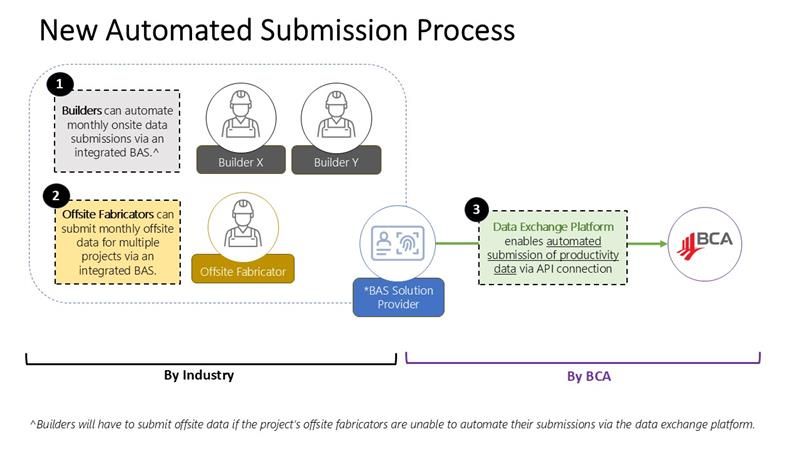
What’s Actually Changing (And What Isn’t)
A common misconception is that automated CPD simply means exporting attendance data from existing systems.
That is not what the circular describes.
While BCA defines the submission pathway and the required data structure, it does not prescribe how contractors should redesign their internal workflows. As a result, many readiness gaps only surface during implementation.
In practical terms, automated CPD means:
- Workforce data must already align with BCA’s required fields
- Identity, employer details, trade classification, and attendance timing must exist in a consistent, structured format
- CPD submission is no longer a standalone month-end task, but a continuous outcome of how data is captured upstream
Where Most Systems Will Break
Under the new framework, attendance is no longer “raw input”.
It becomes regulated data — structured, attributable, and expected to be audit-ready by default.
This means:
- Workforce identity must be unambiguous (NRIC / FIN)
- Employer and client mapping must be correct (UEN-level)
- Trade classification must follow a standard schema
- Time-in / time-out must be clean enough for productivity computation
If any of this requires fixing after the month ends, the system is already misaligned.
This is not spelled out in the circular, but it is where CPD processes typically break in practice:
Split Sources of Truth
Attendance is captured in one system, worker profiles live in another, and trade tagging is corrected manually later.
Excel as the “last mile”
Data appears operationally complete, but only becomes CPD-ready after reconciliation in spreadsheets.
Errors Discovered Too Late
Issues such as incorrect employer, wrong trade, or missing hours surface during submission or audit — not at the point of data capture.
In reality, this often looks like a subcontractor who checks in correctly on site but is later tagged under a different employer or trade during month-end CPD preparation — a gap that only becomes visible when submission or clearance is already approaching.
Automation removes the buffer that previously masked these weaknesses. For organisations operating projects under Regulation 10 — especially those managing multiple projects, subcontractors, or mixed onsite/offsite workflows — early preparation becomes critical.
Contractor Readiness Checklist: What to Check Now
Based on the new workflow, contractors should review their current site systems and vendors against the following:
- Data completeness
Can you reliably capture the required fields, particularly trade classification, employer/client UEN mapping, and time-in/time-out? - Data consistency across subcontractors
Are worker identities and company relationships recorded consistently, or do they vary by project or subcontractor? - Submission pathway
How will CPD be submitted under the integrated BAS → SGBuildex approach from May 2026 for new applicable projects? - Audit/clearance readiness
BCA reminds builders to ensure CPD submissions are complete and accurate before applying for as-built Buildability and Constructability clearance. Gaps discovered late in a project can become a real operational risk.
Systems that depend heavily on reconciliation or manual preparation may require changes to align with the new framework.
A Useful Question to Ask Your Vendors
Instead of asking: “Can this system export CPD?”
It may now be more useful to ask: “How does this system support automated CPD submission under BCA’s new framework?”
That distinction matters as manual submission processes are phased out.
In practical terms, CPD-ready platforms should be able to:
- Capture workforce identity consistently
- Support standardised trade classification
- Reuse manpower records across projects
- Transmit data without file handling
- Highlight gaps early — not at submission time
Anything less pushes risk downstream — to operations teams, compliance checks, or project clearance.
Final Thought
Automated CPD doesn’t just change the upload method — it changes how early you need confidence that workforce data is complete, structured, and consistent.
Some platforms, including Hubble, are being built and validated in alignment with this direction. Regardless of platform choice, contractors who start assessing readiness early will be far better positioned than those reacting closer to 2026.
Frequently Asked Questions on Automated CPD Submission
For quick reference, here are answers to common questions contractors are asking about automated CPD submission.
1. What is automated CPD submission in Singapore?
Automated Construction Productivity Data (CPD) submission refers to the direct, system-to-system transmission of monthly manpower productivity data to BCA using an integrated BAS connected to SGBuildex, instead of manual collation and Excel uploads to ePSS.
For new applicable projects with PTCW applications made from 1 May 2026, builders will be required to submit CPD through this automated workflow, in accordance with BCA’s circular.
2. When does automated CPD submission become mandatory?
Automated CPD submission via an integrated BAS connected to SGBuildex applies to new applicable projects with PTCW applications made from 1 May 2026. Builders may also choose to onboard earlier on a voluntary basis.
3. Who needs to comply with automated CPD submission requirements?
The requirement applies to projects governed under Regulation 10 of the Building Control (Buildability & Productivity) Regulations 2011. Contractors involved in such projects should assess whether their current systems support automated submission.
4. Does automated CPD submission replace ePSS?
Automated CPD submission replaces the manual collation and Excel upload process traditionally associated with ePSS. Under the new framework, CPD data is transmitted directly and automatically to BCA via an integrated BAS and SGBuildex.
5. What data is submitted under automated CPD?
BCA’s circular lists manpower data fields such as:
- NRIC/FIN (UIN)
- Work pass type
- Trade classification
- Employer and client company names and UENs
- Attendance date, time-in, and time-out
These fields form part of the standardised data schema used for automated submission.
6. Can contractors still submit CPD manually after May 2026?
For new applicable projects from 1 May 2026, CPD submission is intended to be done through integrated systems, not manual Excel uploads. Contractors with ongoing projects may be allowed to onboard earlier on a voluntary basis.
Share this article
Explore Related Content
Stay up to date with our latest news features!

CPD Trade Data for SGBuildex — Mapping, Multi-Skilled Workers, and Mid-Project Changes

Mobile Biometric Check-In for SGBuildex CPD — Open Sites, Space Constraints, and Business Continuity