
The Hidden Cost of Contractor Onboarding Isn't the Paperwork. It's the Delay.
Contractor onboarding is meant to ensure workers and equipment are qualified and ready for deployment. But repeated paperwork, fragmented records and lengthy approval processes are creating avoidable costs for organisations and their contractors.
Contractor onboarding can become expensive when the same information must be collected, verified and entered repeatedly across projects and worksites. Administrative work, delayed approvals and poor visibility into resource readiness can add costs before work even begins.
New industry research suggests the extent of the problem may be greater than many organisations recognise.
A 2026 survey by contractor compliance provider TEAM found that 76% of 600 US contractors surveyed had experienced delays to their planned start dates because of clearance-to-work requirements. Among respondents, 64% reported repeating paperwork, testing or appointments at least twice.
While the research covers US contractors in construction, oil and gas, and healthcare rather than Singapore or Southeast Asia, it highlights a broader operational challenge: ensuring contractors meet compliance requirements without allowing the administrative process itself to become a barrier to mobilisation.
Why Does Contractor Onboarding Take So Long
Often, the information exists already. It just cannot move through the process efficiently.
Administrators request the same worker details that another project collected last month. Subcontractors email certificates one by one. Safety personnel check documents against requirements. Missing information sends the submission back. The next project starts from scratch.
The TEAM survey identified several recurring sources of delays.
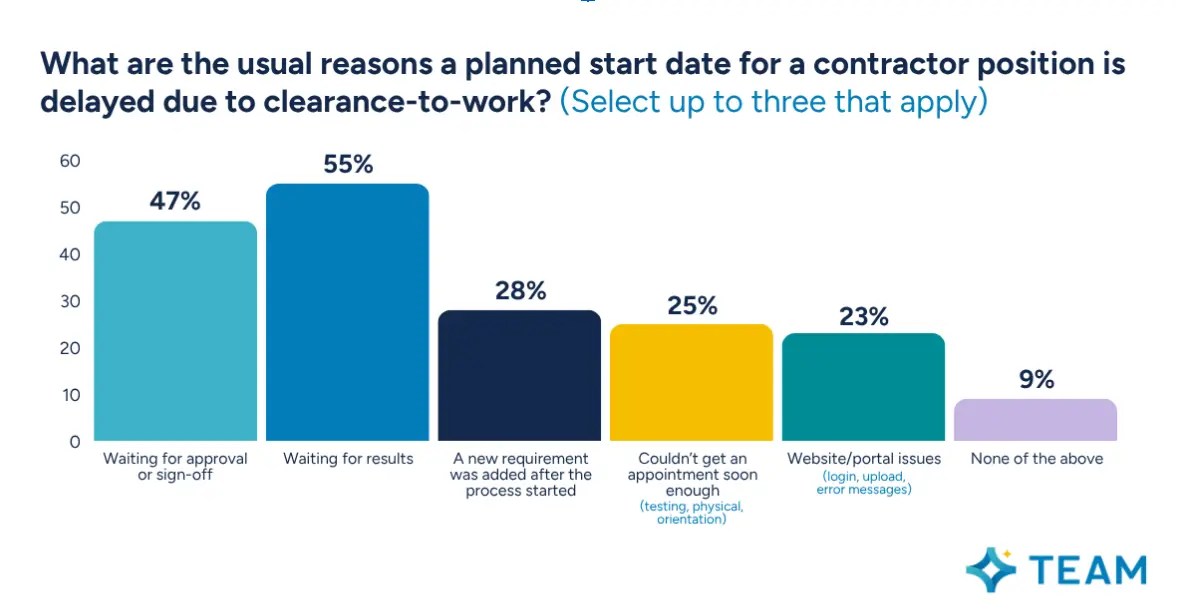
These findings reveal an important distinction: digitising contractor registration does not necessarily eliminate the delays that occur after documents have been submitted.
A contractor may upload the required records successfully, only to wait for document verification, additional information or sign-off from different approval authorities.
Rework can add another layer of administrative effort.
In the same survey, respondents cited missing or incorrect paperwork (45%), new requirements introduced during the process (43%) and rejected uploads (32%) as reasons for having to repeat clearance steps.
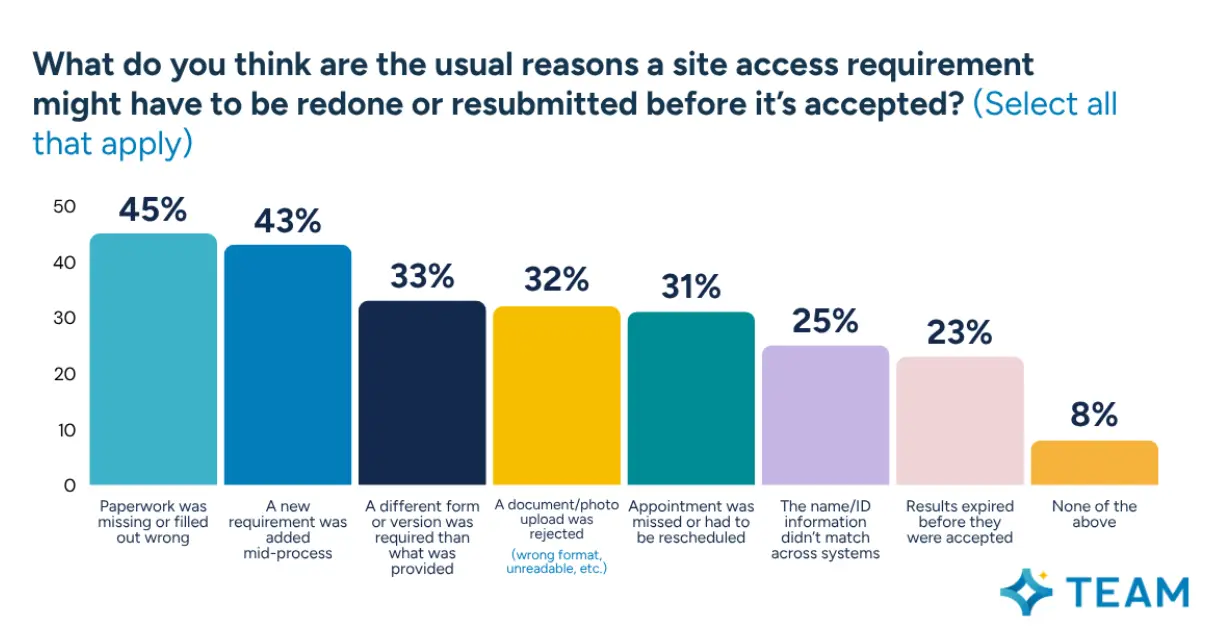
When different parties manage submissions, reviews and approvals, an incomplete record can trigger another round of communication, resubmission and waiting.
The Operational Impact Goes Beyond Paperwork
Contractor onboarding costs are often absorbed into general project administration or operational overheads, making them difficult to identify as a separate expense.
But inefficient onboarding can affect both the organisation engaging contractors and the companies supplying the workforce.
For contractors, delayed clearance may mean workers cannot begin their scheduled assignments, resulting in idle time, rearranged deployments or additional travel in some cases.
TEAM's survey found that 42% of respondents experienced lost or unpaid time associated with site access requirements.
The impact can also extend to future contractor availability. Some 39% said a frustrating site access experience had made them less likely to pursue work at the same site again.
For organisations managing multiple projects, repeated mobilisation delays can make workforce planning and project execution less predictable.
Why Organisations Keep Onboarding the Same Contractors Repeatedly
One reason contractor onboarding creates unnecessary work is that information is frequently organised around individual projects rather than reusable resources.
Consider a company working with the same subcontractor across several projects.
The subcontractor's business information, worker identities, qualifications and equipment details may already exist in the organisation's records.
However, if each project maintains a separate contractor database, the same information may need to be submitted and processed again.
This creates duplication at several levels:
- Company registration: Recollecting bizSAFE, ISO, insurance and other corporate documentation from contractors already known to the organisation.
- Worker onboarding: Identity details, employment records and relevant competency certificates may be entered into multiple systems.
- Equipment registration: Machinery and equipment details, inspection documents and certifications may be repeatedly submitted.
- Document review: Different project teams may review the same underlying information without access to previous checks or decisions.
Not all repeated checks are wasteful.
A certificate may have expired since the previous project. A Work Pass may no longer be valid. A new site may impose different competency, induction or approval requirements.
The opportunity is not to remove those safeguards. It is to stop rebuilding information that already exists, while continuing to enforce the checks that matter at each site.
That requires two separate decisions: who or what is this resource, and is this resource approved for this project?
Four Ways to Reduce Contractor Onboarding Delays
1. Put Preparation Back with the Contractor
Contractors know their workers, qualifications and equipment best. Give them a controlled way to register records, supply supporting documents and correct incomplete submissions.
Your internal team should review and decide—not key in every field on the contractor's behalf.
2. Use AI for the Repetitive Work
Work Passes and training certificates contain information that administrators would otherwise type manually.
AI-assisted processing can extract supported fields and prepare records for human checking. It does not replace authoritative status verification or approval.
3. Make Clearance Requirements Visible Before Submission
Define the documents and conditions a worker, contractor or piece of equipment must satisfy. Show what is missing early, instead of discovering it after the requested start date.
4. Reuse Records Where Relevant
For organisations managing multiple sites, a company-level resource directory can reduce repeated registration. The receiving site or project still decides whether each resource meets its requirements. Central registration and site-level enrolment are complementary, not interchangeable.
Moving From Repeated Onboarding to Reusable Resource Management
Hubble's AI-Powered Resource Management System brings contractor preparation, AI-assisted document processing and project enrolment into a connected resource-management workflow.
Contractors and service partners can prepare their own information. AI Agents assist with Work Passes and certificates processing for human review.
Project or site teams review enrolment requirements and make approval decisions.
And resource management need not stop at approval. Hubble can connect enrolment with relevant workforce, site-access and safety processes, ensuring the right worker and machine is cleared for the site and qualified for the job.
The result is a better division of labour: contractors prepare, software reduces manual handling, and your team retains control of who is accepted.
Measuring the Actual Cost of Contractor Onboarding
Metric | What it reveals |
| Average time from submission to approval | Overall onboarding turnaround |
| Administrative processing time per resource | Direct workload involved in onboarding |
| Percentage of records requiring resubmission | Documentation quality and rework |
| Number of duplicate resource registrations | Repeated data collection |
| Percentage of resources cleared before planned mobilisation | Workforce and equipment readiness |
| Time spent waiting for verification or approval | Bottlenecks beyond data entry |
These reveal whether your onboarding system is simply storing documents—or helping work start on time.
The Bottom Line
Contractor onboarding will always require checks. It should not require the same avoidable administration every time a worker changes sites.
Stop measuring success by how quickly a form can be submitted. Start measuring how reliably people and equipment can become ready for the work ahead.
See how Hubble Resource Management can streamline contractor onboarding and mobilisation. Request a demo.
Share this article
Explore Related Content
Stay up to date with our latest news features!

The Hidden Cost of Contractor Onboarding Isn't the Paperwork. It's the Delay.
MOM Work Pass Verification for Contractors: From Registration to Site Access